

CMS recently announced the Long-term Enhanced ACO Design (LEAD) Model, which is set to replace ACO REACH on January 1, 2027. With a 10-year performance period running through 2036, LEAD represents a significant commitment to the future of value-based care.
Pearl is monitoring these developments to help our partners navigate this transition. Here is a breakdown of what we know so far and the critical questions we hope will be answered when the Request for Applications (RFA) is released in March 2026.
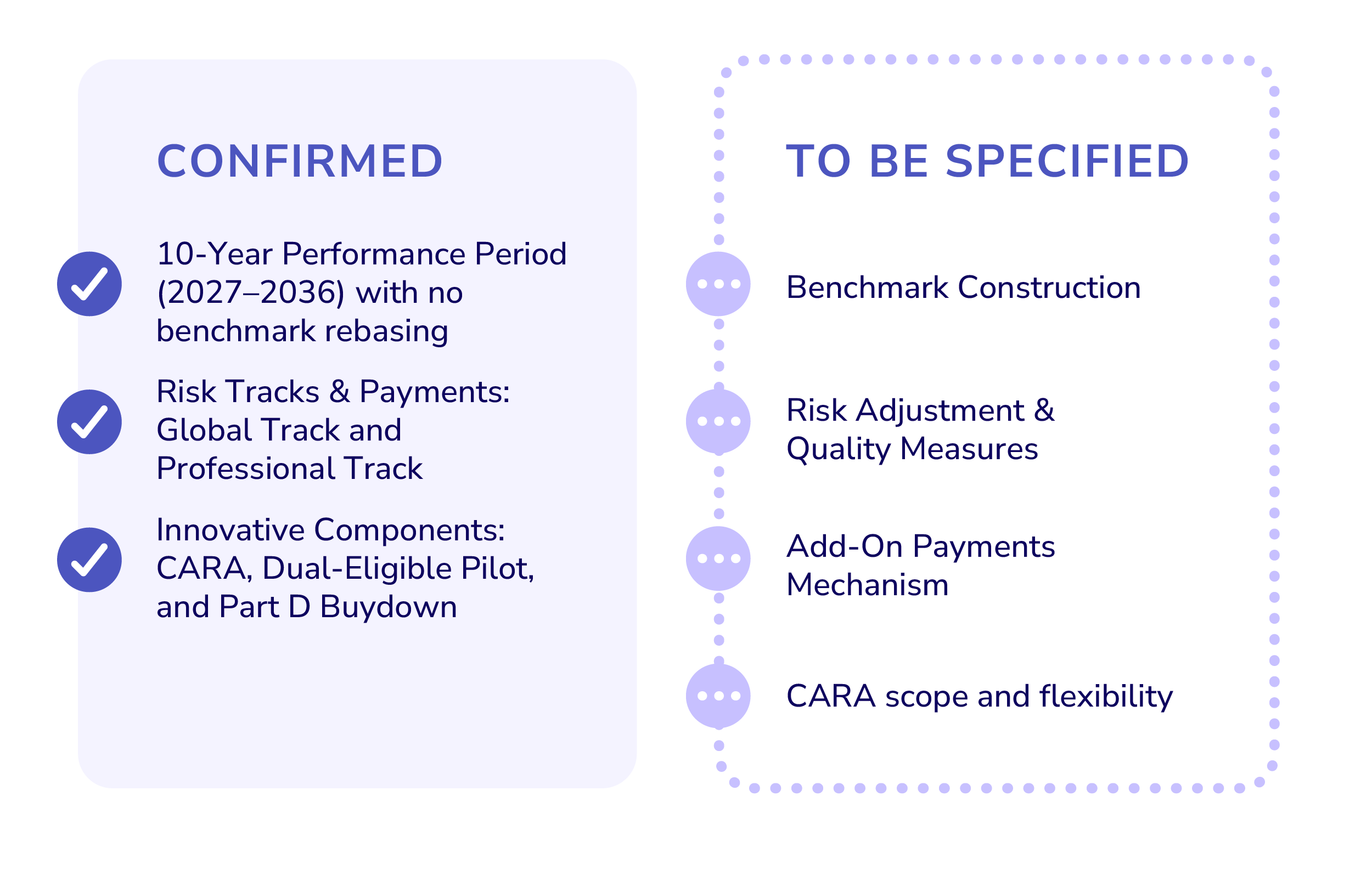
What’s Confirmed: The Core of LEAD
The LEAD model introduces several structural elements designed to provide stability and enhance value-based care:
Decade of Stability
The model features a 10-year performance period (2027-2036) with no benchmark rebasing, offering ACOs a long-term horizon for seeing the results of their care coordination and quality improvement efforts. This is in contrast to the 4-year model provided by ACO REACH.
Risk Tracks & Payments:
Building on ACO REACH, LEAD offers two risk tracks:
- Global Track: 100% shared savings and 100% downside risk.
- Professional Track: 50% upside and 50% downside risk.
Both tracks use prospective capitated payments.
Targeted Population Focus
LEAD has an enhanced focus on rural, high-needs, and dual-eligible beneficiaries, including adjustments to improve outcomes for these specific groups - groups that historically have been excluded or had low participation in value-based care programs.
Innovative Components of LEAD
CMS has introduced several new features in the LEAD model to give ACOs more flexibility and better support for patients:
- CARA (CMS Administered Risk Arrangements): This program gives specialists a clearer role in total-cost-of-care efforts. ACOs and specialists can collaborate to design mutually agreed-upon care episodes, with an initial focus on preventing falls.
- Dual-Eligible Integration Pilot: A pilot program in two states will better coordinate care for Medicare-Medicaid beneficiaries, aiming to address historically fragmented services for this high-needs population.
- Part D Premium Buydown (starting 2029): ACOs will have the ability to subsidize Part D co-pays and premiums, helping patients stay on their medications and improving overall outcomes.
The Critical Unknowns: What We’re Watching
While the framework is clear, the technical details will determine the model’s viability for different provider types. We’re seeking clarity on several key areas that are likely to be clarified in the forthcoming RFA:
1. Benchmark Construction & Trends
There are still a lot of unanswered questions about how CMS will set benchmarks under LEAD. Crucially, how will regional spending trends be balanced with historical performance? And how will the model avoid the “ratchet effect,” where high-performing ACOs end up with lower benchmarks over time? We’re also watching to see whether alignment will happen at the TIN or TIN-NPI level, and whether benchmarks will be based on prospective or retrospective trends.
2. Risk Adjustment & Quality
We are curious to see if CMMI will apply the concurrent risk adjustment methodology used in ACO REACH for high-needs populations. On the quality front, will LEAD continue REACH’s move toward outcomes and claims-based measures, or will it lean back toward the relatively reporting-heavy process measures found in MSSP? Will there be similar cliffs as in ACO REACH related to quality performance?
3. Support for Independent Providers
CMMI has said that LEAD is designed to make participation feasible for small, rural, and independent providers. One promising feature is an unreconciled “add-on payment” to help these providers build the infrastructure needed to join an ACO. We’re looking forward to learning more about how these incentives will work.
4. Specialist Integration (CARA)
While CARA allows for specialist contracting, the scope of flexibility and clinical use cases remain undefined. It is currently unclear if the model itself will incentivize specialists or if the financial burden will fall on ACOs. Will CARA leverage the Preferred Provider construct as currently in place with ACO REACH?
Looking Ahead
As with ACO REACH, the “devil is in the details.” The technical decisions regarding benchmark levers, risk score caps, and capitation flexibility will decide who is best suited for this model.
Stay tuned with Pearl Health. We plan to break down the RFA in March 2026 and what success might look like in this next era of value-based care.

Pearl Health is powering the future of healthcare
We’re a team of physicians, technologists, and risk-bearing experts with a passion for enabling our partners to deliver better care and reduce health system costs. Want to learn more?